Using Twitter to predict retail foot traffic
Our online and offline lives are increasingly blurring together, affecting how we interact and how we shop. Despite a wide literature on the relationship between digital word-of-mouth communication and e-commerce, research has said comparatively little about whether online discussions translate into in-person sales of national brands.
Research question
My new co-authored paper takes on the widest study to date about how social chatter predicts brick-and-mortar sales. You can now view "Twitter-patter: how social media drives foot traffic to retail stores" available in the Journal of Marketing Analytics. We address the question: do tweets mentioning a brand signal future demand for that retailer?
Data
We identified 3,870 stores between 15 nationally-known retail brands with names that can be easily distinguished on Twitter (e.g., Petco, not Target). We then collected 2.7 million tweets mentioning one of those brands and acquired data from 15.7 million store visits.
Methods
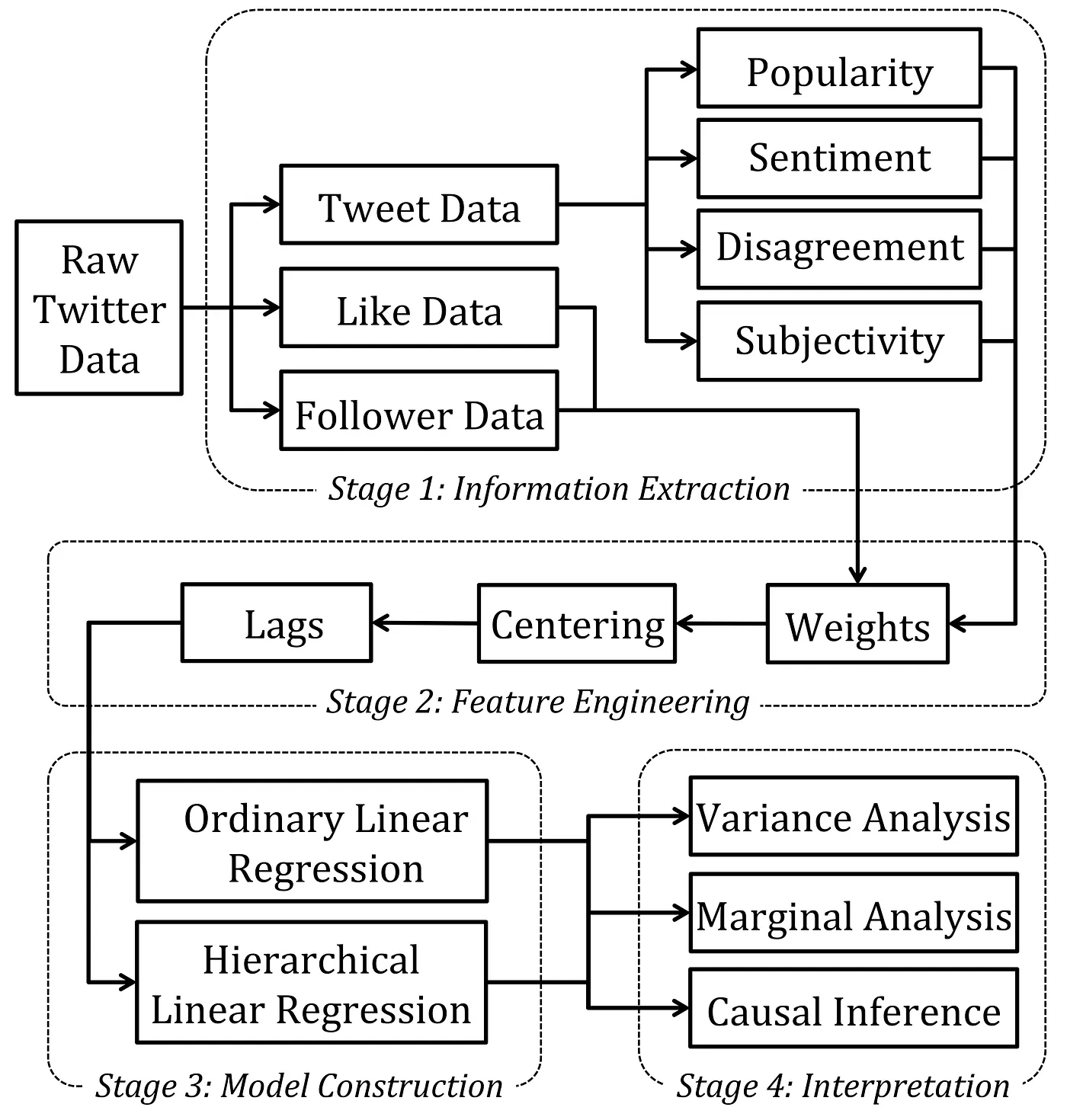
The next step was to define different measures of social media activity to estimate how changes in those values correspond to changes in foot traffic. Specifically, we used hierarchical linear regression to properly account for how tweets mentioning a brand influence customers to visit, not the brand itself, but physical stores of that brand.
The overall approach is best summarized in the diagram below.
Results & Discussion
I highlight the top seven results of the paper with recommendations for both researchers and practitioners.
1. Sentiment is a popular way to analyze text, but here we found the intra-day spread of sentiment was a more useful measure than average sentiment. We call this “disagreement”.
- We suggest researchers and data scientists use sentiment disagreement as a way to capture how diverse opinions are on a given day.
- Brand managers should be cautious about applying the wider word-of-mouth literature to brick-and-mortar settings. Most research relates only to online sales where effects can be 10–20 times larger.
- Further research should analyze how this compares with other social media platforms since Twitter is known as being particularly short-term and reactive.
- Further research should explore if these results hold for lesser-known retail brands.
- We suggest marketers do not generalize these results too much, and where possible, estimate the effects for their own brand.
- Regardless of which is true, we recommend economists and data scientists use social media activity in sales forecasts, as we find it to be a useful leading indicator.
- For data scientists, if your data is multilevel (e.g., various products located in various stores), it should be modeled as such.
Conclusion
Twitter has a modest and meaningful effect on retail foot traffic; however, the impact varies widely by the individual brand and store. See
the paper
for more details, and reach me on
LinkedIn
if you have any questions.
Special thanks to my wonderful co-authors: Kuanchin Chen, Susan Pozo, and Michael J. Ryan.
This article was originally published on Medium.
Post details
- Thomas J. Weinandy, Ph.D.
- 2023-02-14
- ~5 min read
- Economics, Retail